refreshi

What Happens to Unsold Food at Your Favourite Restaurant? The Truth Might Surprise You.
Refreshi Team · June 2026 · 5 min read
Every evening, when your favourite restaurant closes its kitchen, there's food left over. Bread that didn't sell. Portions of today's special. Desserts that sat in the display case all day. Prepared salads. Fresh soups. In a busy restaurant, this can amount to tens of thousands of rands of food every week.
So where does it go?
The three routes unsold food takes — and why none of them are ideal
Route 1: The bin. Most surplus food, across most food businesses, ends up in the bin. It's the default — not because businesses want to waste food, but because managing surplus takes time, systems, and logistics that most kitchens don't have at the end of a long service. A restaurant team that's been on their feet since 6am doesn't have the capacity to manage a food rescue programme after closing.
Route 2: In-store markdown. Some businesses try to discount unsold food in the last hour of trading. But this can undermine full-price sales earlier in the day — and it rarely clears the full volume of surplus before closing time. It also requires staff time to reprice and display items, which eats into already thin margins.
Route 3: Donation. Food donation to organisations like FoodForward SA is genuinely valuable — and it's something Refreshi actively supports. But donation has its own constraints: it requires logistics coordination, recipient capacity, and the food has to be collected on time. Most food businesses can't reliably manage this every single day.
"The problem isn't that food businesses want to waste food. It's that until recently, there was no easy alternative."
What happens when food goes to landfill
When food ends up in landfill, it decomposes and produces methane — a greenhouse gas 80 times more potent than CO₂ over a 20-year period. Globally, food waste is responsible for 8–10% of all greenhouse gas emissions. In South Africa, we lose an estimated 10 million tonnes of food annually — worth approximately R60 billion — through the food supply chain.
The environmental cost of that waste is staggering. Embedded in every kilogram of wasted food is the water used to grow it, the land used to farm it, and the emissions generated in producing, transporting, and refrigerating it — all for nothing.
0.0M tonnes
Food wasted in South Africa annually
R60 billion
Estimated annual economic cost of SA food waste
5%
Share of global greenhouse gas emissions from food waste
There is now a better route
Refreshi gives food businesses a fourth option — one that fits into existing close-down routines, requires no new equipment, and generates revenue instead of cost.
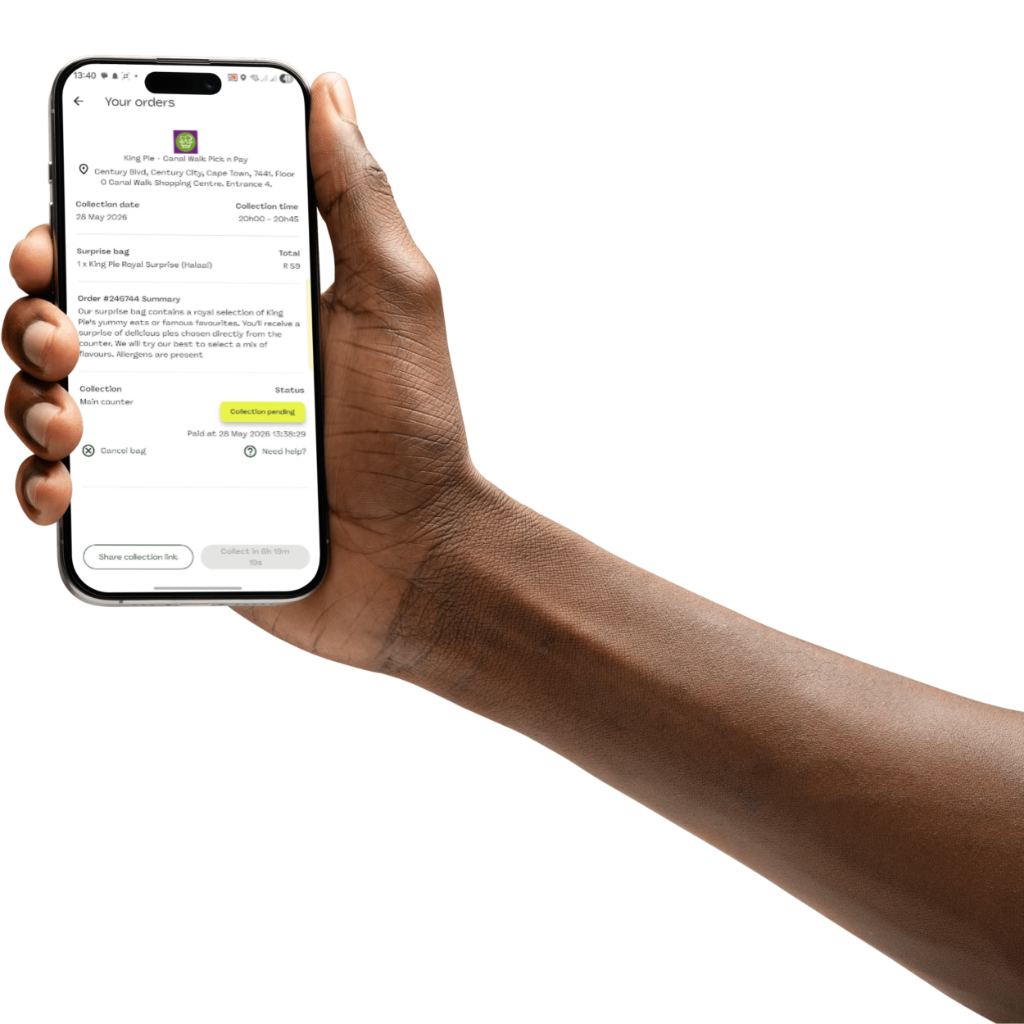
At the end of service, staff pack unsold food into Surprise Bags and list them on the Refreshi app. Nearby customers reserve, pay in-app, and collect during a defined window. The store recovers revenue from food it would otherwise bin, saves on waste disposal, and the food reaches someone who's happy to have it.
The whole process takes under five minutes to set up each day. Most stores go from onboarding to first bag sold within 24 hours.
Ready to turn your surplus into revenue?
Join 700+ stores already on Refreshi. No upfront cost. No complicated setup. First bag live within a day.
What about FoodForward SA?
When surplus food can't be sold through the Refreshi app — either because volumes are too large or because the timing doesn't work for consumer collection — Refreshi works with FoodForward SA to ensure it still reaches communities that need it. FoodForward SA is South Africa's largest food bank, redistributing nutritious food to over 700 organisations serving vulnerable communities across the country.
Together, Refreshi and FoodForward SA represent both ends of the surplus food solution: commercial redistribution and community redistribution. Learn more at foodforwardsa.org.
More from the Refreshi blog
5 Things You Didn't Know About Food Waste in South Africa
South Africa wastes 10 million tonnes of food every year. Here are five facts that will change how you think.
5 min readImpact & News173,000 bags rescued. R11.3M generated. Here's the full picture.
Our first full impact report — real numbers from real partners across every food sector.
8 min readPartner StoriesWhy South Africa's Hospitality Industry Has a Food Waste Problem
Hotels generate the highest per-outlet bag volume of any category on Refreshi.
7 min read

We use cookies to improve your experience and measure our impact. Read our Cookie Policy.